
Report / Batteries & Energy Storage
Four Fronts, One Race: What's Actually Happening in Battery Technology Right Now
Sodium-ion, silicon anode, solid-state and raw-material policy are all moving at once, on different clocks. Here is what the public record actually shows, and what each front means for a sourcing, technology or market-entry decision.
14 July 2026 · 12 min read
The Problem: Everyone's Betting on a Different Battery
Ask five people in the energy storage industry which battery chemistry wins the next decade, and you'll get five different answers sodium-ion, solid-state, silicon anode, next-gen LFP. The honest answer is that none of them are wrong. As of mid-2026, the battery industry isn't converging on one winning technology; it's fracturing into parallel tracks that are all advancing at once, each on its own commercialization clock, each pulling on a different part of the supply chain.
For a manufacturer, materials supplier, investor, or licensing strategist trying to decide where to place a bet or where to scout a technology, a supplier, or a competitor that fragmentation is exactly the problem. Reading one headline ("CATL launches mass-produced sodium-ion batteries") without reading the other three (the solid-state race, the silicon anode scale-up, and China's on-again-off-again export controls on battery materials) gives an incomplete, and potentially misleading, picture of where to move next.
This brief pulls together what the public record company disclosures, regulatory filings, and patent-filing data actually shows about four fronts moving simultaneously in the battery industry as of mid-2026, and what each means for anyone making a sourcing, technology, or market-entry decision in this space.
Four Fronts, Moving at Different Speeds
1. Sodium-Ion Goes From Lab Curiosity to Shipping Product
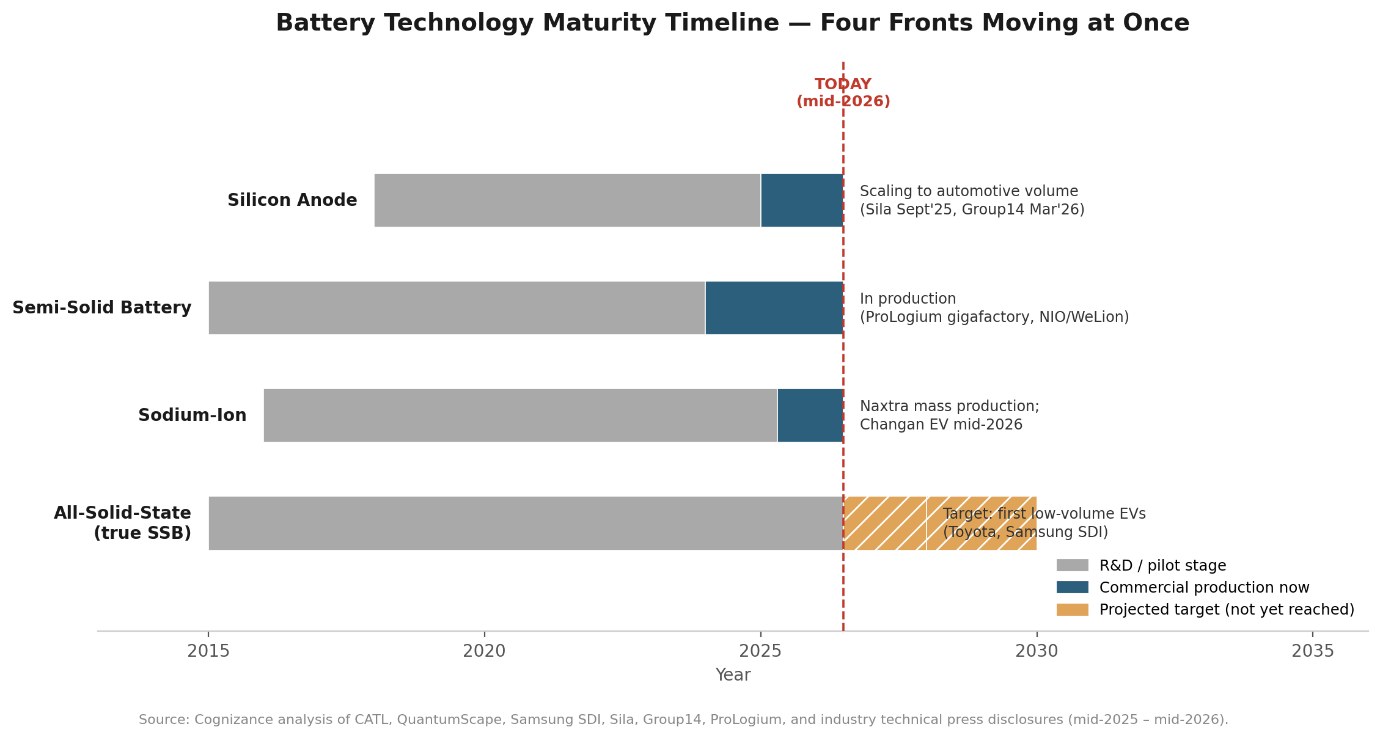
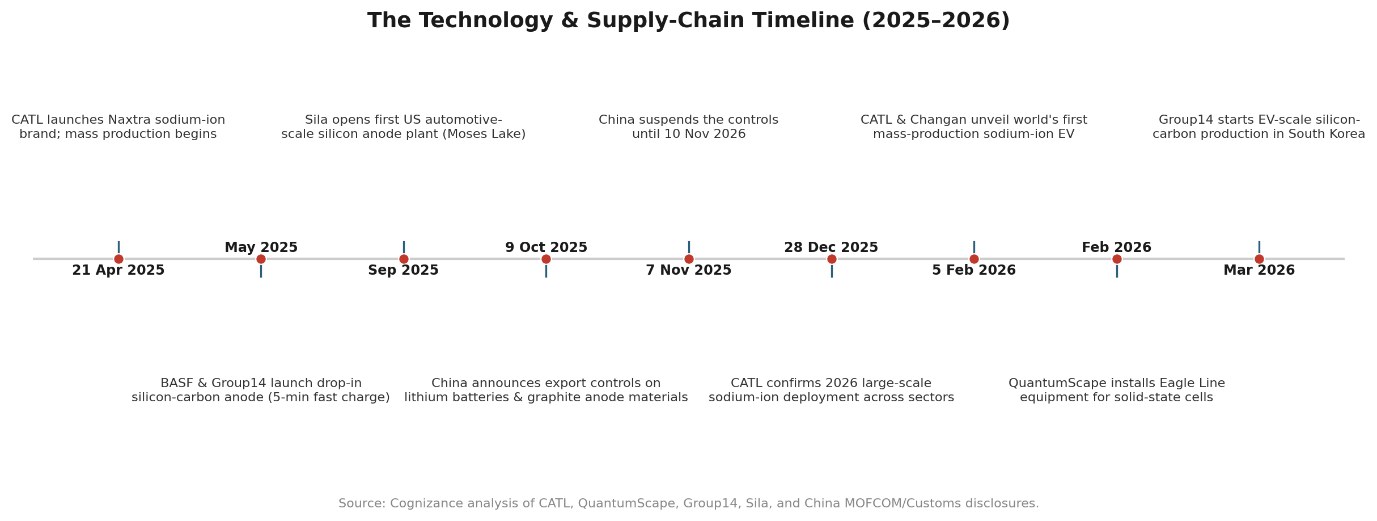
This is the front that moved fastest and furthest in the past twelve months. CATL the world's largest battery maker launched its Naxtra sodium-ion brand on 21 April 2025, describing it as the world's first large-scale mass-produced sodium-ion battery line, covering both passenger-vehicle power batteries and a 24V integrated battery for heavy trucks, engineered to operate across a −40°C to 70°C range.
The pace since then has been rapid:
- In September 2025, CATL announced its next-generation sodium-ion battery reaches an energy density of 175 Wh/kg nearly on par with mainstream LFP lithium-ion cells and supports over 500 km of pure-electric driving range. That cell became the first sodium-ion battery worldwide to pass China's updated national EV traction-battery safety standard, GB 38031-2025.
- On **28 December 2025**, at its Ningde supplier conference, CATL confirmed plans to deploy sodium-ion technology at scale across battery-swap systems, passenger vehicles, commercial vehicles, and stationary energy storage through 2026.
- On 5 February 2026, CATL and Changan Automobile unveiled the world's first mass-production passenger EV built on sodium-ion cells reaching market by mid-2026 across Changan's AVATR, Deepal, Qiyuan, and UNI brands alongside plans for more than 3,000 battery-swap stations across 140 Chinese cities by the end of 2026.
CATL isn't alone. BAIC's Aurora sodium-ion pack reports energy density above 170 Wh/kg with roughly 20 patents filed and a mass-production process for prismatic cells already established. BYD, building a dedicated sodium-ion facility in Xining since January 2024, has moved to a third-generation platform reporting cycle life up to 10,000 cycles. Industry tracking shows the current sodium-ion market is still concentrated roughly 79% of installed capacity is in stationary energy storage, not EVs and China holds more than 60% of the global market and over 95% of installed and announced capacity through 2030.
2. Silicon Anode Moves From Niche to Automotive Scale
Silicon anode technology a drop-in replacement for the graphite anode that boosts energy density and charging speed has been commercially shipping in small volumes since 2018 (Amprius), but 2025-2026 marks its shift toward automotive-scale manufacturing:
- **May 2025:** BASF and Group14 Technologies launched a "drop-in-ready" silicon-carbon composite (SCC55) compatible with existing battery factories, capable of reaching 80% state of charge in under five minutes and holding over 1,000 cycles at 80% capacity retention.
- **September 2025:** Sila Nanotechnologies began operations at what it describes as the first automotive-scale silicon anode plant in the US, in Moses Lake, Washington, producing its Titan Silicon material with initial capacity of 2-5 GWh.
- **November 2025:** Umicore and HS Hyosung Advanced Materials formed a joint venture to industrialize silicon-carbon anode materials, with a demonstration plant planned in Belgium for 2026.
- March 2026: Group14 started EV-scale production at its Sangju, South Korea facility for SCC55, designed for roughly 2,000 metric tons of material annually enough to support approximately 10 GWh of battery capacity.
3. Solid-State Batteries Are Still the Longer Race
Unlike sodium-ion, true all-solid-state batteries (as opposed to the "semi-solid" hybrid cells already shipping from ProLogium and NIO's partner WeLion) remain in the pilot stage. QuantumScape installed key equipment for its "Eagle Line" combining its Cobra separator process with automated cell production in February 2026, aimed at meeting customer demand for its QSE-5 cells; the company's FY2025 annual report also cites an expanded licensing and collaboration agreement with Volkswagen's PowerCo, two new automotive OEM customers added to its portfolio, and a live public demonstration of its lithium-metal cells in a Ducati race motorcycle. Samsung SDI is targeting 2027 for mass production of its all-solid-state cells and has partnered with BMW and Solid Power to validate sulfide-based cells in a demonstration vehicle. Toyota, which industry trackers describe as holding the deepest solid-state IP portfolio of any automaker, has reportedly received Japanese government certification to begin solid-state production in 2026, with EV-ready output targeted for 2027-2028. China is set to release its first national solid-state battery standard in July 2026. Industry roadmaps broadly converge on 2027 as the first milestone for low-volume solid-state EVs, and 2030 as the point at which meaningful mass-market volume becomes plausible.
4. Raw Materials Just Had a Whiplash Moment
The fastest-moving and most consequential for anyone doing supply-chain planning development wasn't a battery announcement at all. On 9 October 2025, China's Ministry of Commerce and General Administration of Customs jointly announced export controls (Decision No. 58) covering lithium-ion battery cells and packs with energy density of 300 Wh/kg or higher, cathode materials and precursors, and artificial graphite anode materials and related manufacturing equipment placing them on China's dual-use export control list and requiring licenses for export, effective 8 November 2025. China controls roughly 75% of global natural graphite production and dominates downstream spherical-graphite processing for battery anodes, making the move highly consequential for battery supply chains worldwide.
Then, just one day before the controls were due to take effect, China reversed course: on 7 November 2025, MOFCOM and Customs issued a suspension decision, immediately lifting the restrictions on lithium batteries, graphite anode materials, and related equipment and technology alongside a parallel suspension of related rare-earth export controls with the suspension set to remain in force until 10 November 2026. A related announcement on 9 November 2025 separately eased end-user verification requirements specifically for graphite shipments to the United States, valid through 27 November 2026.
The net effect: the restrictions never actually took hold, but the whiplash announced, then suspended within a month, with the suspension itself expiring in November 2026 is now a standing feature of supply-chain risk planning for any company sourcing graphite, cathode materials, or high-density cells out of China.
The Timeline, at a Glance
The Patent Layer
Underneath all four fronts, the patent-filing data tells its own story about where R&D intensity is actually concentrated and it's a story Cognizance is built to read.
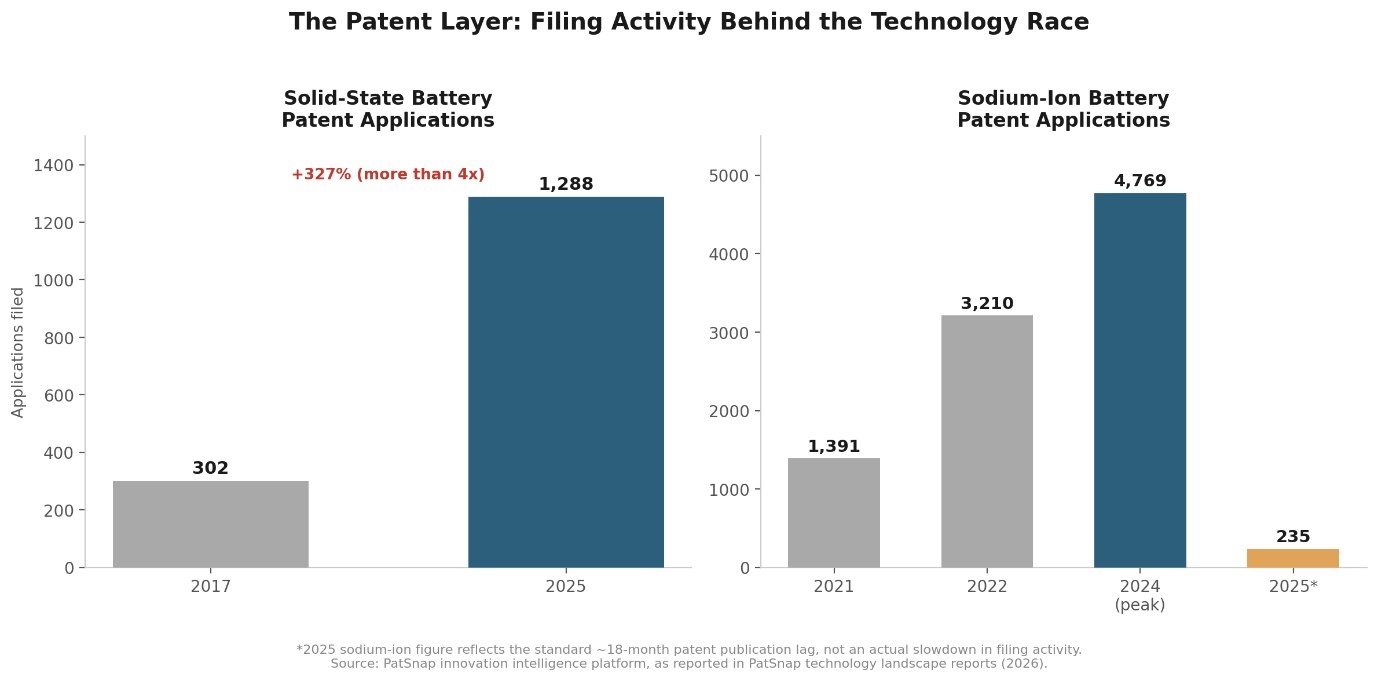
Solid-state battery patent applications grew more than four-fold between 2017 and 2025, rising from 302 to 1,288 filings, with the steepest acceleration occurring after 2021 as automakers pushed for commercial-ready timelines. LG Energy Solution currently holds the most active solid-state patent position of any single company 77 key patents, including 18 focused on energy density and 12 on ionic conductivity ahead of Samsung SDI, Toyota, Panasonic, and Fujifilm. In March 2026, a newly published international patent application from CATL, filed through WIPO, laid out in detail how the company's solid-state cell and electrolyte materials are engineered to address one of the technology's central manufacturing challenges a signal that CATL, already dominant in lithium-ion and sodium-ion, intends to contest the solid-state patent landscape as well.
Sodium-ion patent filings show the same acceleration pattern one technology cycle earlier: 1,391 filings in 2021 (already a 2.4x jump year-on-year) to 3,210 in 2022 tracking almost exactly with the 2022 spike in lithium carbonate prices continuing to a filing peak of 4,769 in 2024. (The apparent 2025 falloff shown in the chart reflects the standard ~18-month patent publication lag, not an actual slowdown in R&D a pattern worth remembering whenever a "filings are declining" headline crosses your desk.)
At the country level, a separate 2025 battery patent landscape analysis found China leading global filing volume across solid-state lithium-ion, sodium-ion, zinc-ion, and battery recycling technologies, while Samsung and LG Chem led lithium-ion patent families specifically, with Toyota and Panasonic also in the global top 20 and General Motors the highest-ranked Western applicant, at 22nd. The broader pattern: Asian applicants Chinese, Korean, and Japanese are building large, geographically concentrated portfolios, while many Western companies remain comparatively selective in where and how they file.
What This Means for Different Stakeholders
Battery and cell manufacturers evaluating a chemistry bet need to separate "commercially shipping today" (silicon anode, semi-solid, and now sodium-ion) from "still on a multi-year pilot runway" (true solid-state) and plan capital accordingly, rather than treating all four as equally close to market.
Materials and component suppliers particularly in graphite, cathode precursors, and specialty electrolytes are operating in a environment where Chinese export policy can shift in a matter of weeks; the October-November 2025 sequence is a live case study in why supplier scouting and qualification needs to include non-Chinese alternatives as a matter of course, not just as a contingency plan.
Automakers and OEMs selecting a battery partner are effectively choosing a technology-maturity profile as much as a supplier sodium-ion and silicon anode both offer near-term availability with different trade-offs (cost and cold-weather performance versus energy density), while a true solid-state commitment is still a multi-year bet on a 2027-2030 horizon.
Investors and corporate development teams assessing this space need patent-filing data read alongside commercial-production announcements filing volume shows where R&D intensity is concentrated, but as the sodium-ion "2025 dip" shows, filing data on its own can be misread without understanding publication-lag effects.
Licensing intermediaries and technology scouts have a live opportunity in the growing patent-density gap between Chinese filers (dominant in volume) and Western companies (comparatively selective) a gap that typically indicates where white space, cross-licensing, or acquisition opportunities exist for companies without a large in-house portfolio.
How This Kind of Intelligence Gets Built
A brief like this only holds up if the underlying research discipline is sound. The approach we bring to a landscape moving this fast typically combines:
Technology and competitor scouting. Tracking commercialization milestones pilot lines, plant openings, certification passes across every credible chemistry track simultaneously, rather than following whichever one is making headlines this quarter.
**Patent family and filing-trend analysis.** Reading patent volume and ownership concentration as a leading indicator of where R&D investment is actually going, correcting for effects like publication lag that can make recent activity look artificially quiet.
Raw-material and supplier scouting. Mapping qualified graphite, cathode, and electrolyte suppliers including non-Chinese alternatives so that a sourcing strategy isn't caught flat-footed by the next export-control announcement.
Regulatory and geopolitical monitoring as a continuous signal, not a one-time snapshot because as the October-November 2025 export-control sequence shows, the policy environment in this sector can move faster than the underlying technology.
Market research on adjacent demand. Reading where each chemistry's near-term commercial traction is concentrated stationary storage versus passenger EVs versus commercial fleets since that shapes which supply chain and go-to-market questions actually matter first.
Talk to Us
If your organization is evaluating a chemistry bet, a supplier relationship, a licensing position, or a competitive threat anywhere in the battery and energy storage space Cognizance builds exactly this kind of evidence-based, source-verified intelligence for better business decisions: technology and competitor scouting, market research, patent and IP analysis, raw-material and supplier scouting, and licensing strategy, grounded in primary data rather than headline dates.
Facing a decision in this space?
We build this level of evidence around the specific choice in front of you, on your timeline.
Discuss a decision