
Case Study / Beverages
Drinking Less, Choosing Differently: How GLP-1 Adoption Is Rewiring the Beverage Industry
No beverage company decided to sell less alcohol or fewer full-sugar sodas. A molecule class did that to them. Four fronts of the same behavioural shift, and where the capital is already moving.
4 August 2026 · 11 min read
The Problem: A Behavioral Shift the Industry Didn't Choose
No beverage company decided to sell less alcohol or fewer full-sugar sodas. A molecule class did that to them. As GLP-1 receptor agonists Ozempic, Wegovy, Mounjaro, Zepbound have moved from a niche diabetes treatment to a medication used by roughly one in eight to one in nine American adults, they have quietly become one of the most consequential forces reshaping beverage demand in a generation. And unlike a typical category disruption, this one didn't start inside the industry at all it started in pharmacology, and the beverage industry is now reacting to it in real time.
The public data on this shift is unusually well documented for something so recent: national survey organizations, consulting firms, and industry bodies have all been tracking it closely through 2025 and into 2026. Read individually, the data points look like scattered category stories soda companies shrinking their cans, a big non-alcoholic acquisition here, a coffee company splitting in two there. Read together, they show a single underlying dynamic: consumers are drinking less, more selectively, and companies are reallocating capital toward the categories that fit that new behavior.
For a beverage manufacturer, ingredient supplier, or investor trying to decide where to put the next dollar of R&D or M&A spend, understanding that dynamic and which parts of it are durable versus speculative is now a first-order strategic question.
Four Fronts of the Same Shift
1. The Behavioral Data Is Consistent Across Multiple Independent Sources
This isn't a single survey's finding it shows up consistently across separate research organizations using different methodologies:
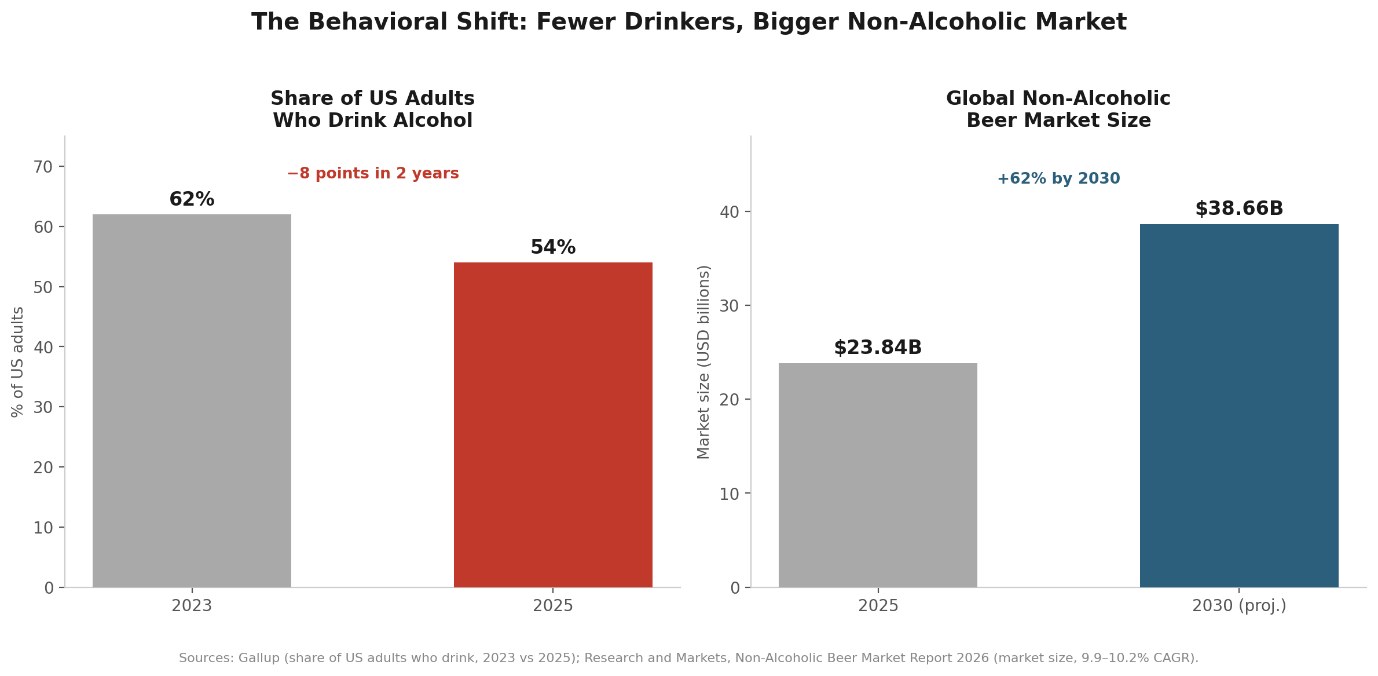
- **Gallup** found the share of US adults who drink alcohol fell from 62% in 2023 to 54% in 2025.
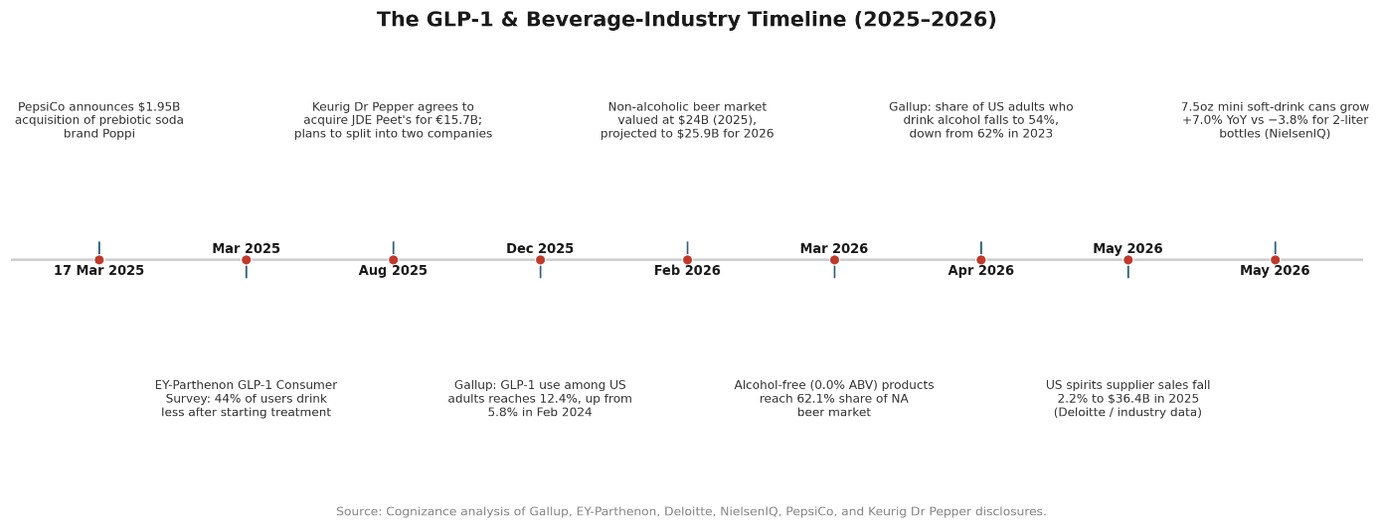
- The same Gallup tracking found GLP-1 medication use among US adults reached 12.4% by late 2025, up from 5.8% in February 2024 while the broader adult US obesity rate fell from 39.9% three years earlier to 37% in 2025.
- EY-Parthenon's GLP-1 Consumer Survey (March 2025) found 44% of GLP-1 users report drinking less after starting treatment, and notably 82% of those who stopped taking the medication kept the reduced-drinking habit rather than reverting.
- **FTI Consulting's** spring 2026 survey found GLP-1 adoption among US adults had risen to roughly 18%, up from about 14% a year earlier, with the 35-54 age cohort showing the highest current adoption at 23%.
- A large randomized trial published in The Lancet in May 2026, enrolling 108 adults with obesity and moderate-to-severe alcohol use disorder, tested semaglutide against placebo alongside cognitive behavioral therapy direct clinical evidence behind what the consumer surveys were already showing anecdotally.
2. Non-Alcoholic and Low-Alcohol Products Are the Clearest Commercial Winner
The category directly benefiting from this shift is growing fast, on real sales data rather than just projections:
- US non-alcoholic beer sales rose 159% and volume grew 111% between 2021 and 2025, now accounting for 2.5% of total US beer volume, according to a Brewers Association study.
- The global non-alcoholic beer market was valued at roughly $23.8-24 billion in 2025 and is projected to grow at a 9.9-10.2% compound annual rate, reaching an estimated $38.7 billion by 2030.
- Within that market, alcohol-free (0.0% ABV) products as opposed to merely low-alcohol reached 62.1% share in 2026, reflecting a consumer preference for a true zero rather than a reduced dose.
- Athletic Brewing Company led the US market with over 12.8% share in 2025, ahead of Heineken, AB InBev, Carlsberg, and Molson Coors, which collectively held 47.2% between them.
- On the alcohol side more broadly, US spirits supplier sales fell 2.2% to $36.4 billion in 2025, and a Deloitte report identified roughly four in ten US consumers as "value seekers" planning to cut alcohol-at-home spending by 20-40% and bar/nightclub alcohol spending by more than half.
3. Capital Is Already Being Reallocated at the M&A Level
The clearest signal that this shift is being treated as structural, not cyclical, is where beverage companies are putting their acquisition dollars:
- On **17 March 2025**, PepsiCo announced a $1.95 billion acquisition of Poppi, the prebiotic ("better-for-you") soda brand, whose 2024 annual sales had passed $500 million. Around the same time, Coca-Cola launched its own competing prebiotic soda, Simply Pop, and rival Olipop raised a $50 million Series C round valuing it near $2 billion.
- In August 2025, Keurig Dr Pepper agreed to acquire Dutch coffee company JDE Peet's for €15.7 billion, with plans to subsequently split the combined business into two separately traded companies Beverage Co. and Global Coffee Co. reflecting a strategic bet that coffee and mainstream soft drinks now warrant distinct corporate structures rather than a single combined portfolio.
- The broader functional beverage market the category both Poppi and Olipop sit in was valued at $134 billion in 2024 and is projected to reach $231 billion by 2033, a growth rate substantially ahead of traditional carbonated soft drinks.
4. Reformulation Is Showing Up in the Physical Product Itself
Perhaps the most concrete evidence of this shift is in packaging and formulation data that has nothing to do with marketing claims:
- For the 52 weeks ending 2 May 2026, sales of 7.5-oz. mini soft-drink cans rose 7.0% while 2-liter bottles fell 3.8%, according to NielsenIQ data cited by AlixPartners. Within low- and zero-calorie soft drinks specifically, mini can sales rose 19.4% while 2-liter format sales fell 1.8% a sharper version of the same trend.
- Beverage companies are responding directly to concerns about lean-muscle loss among GLP-1 users, who can lose up to roughly 40% of total weight loss as muscle mass without adequate protein intake Danone's Oikos brand, for example, launched in the US in 2025 with a high-protein positioning aimed squarely at this consumer.
- Industry commentary from FoodNavigator and BeverageDaily, both reporting in December 2025, converge on the same read: full-sugar soda and standard alcohol categories face continued pressure, but adjacent categories functional, protein-fortified, and portion-controlled formats represent the clearest area of opportunity rather than decline.
The Timeline, at a Glance
The Patent Layer
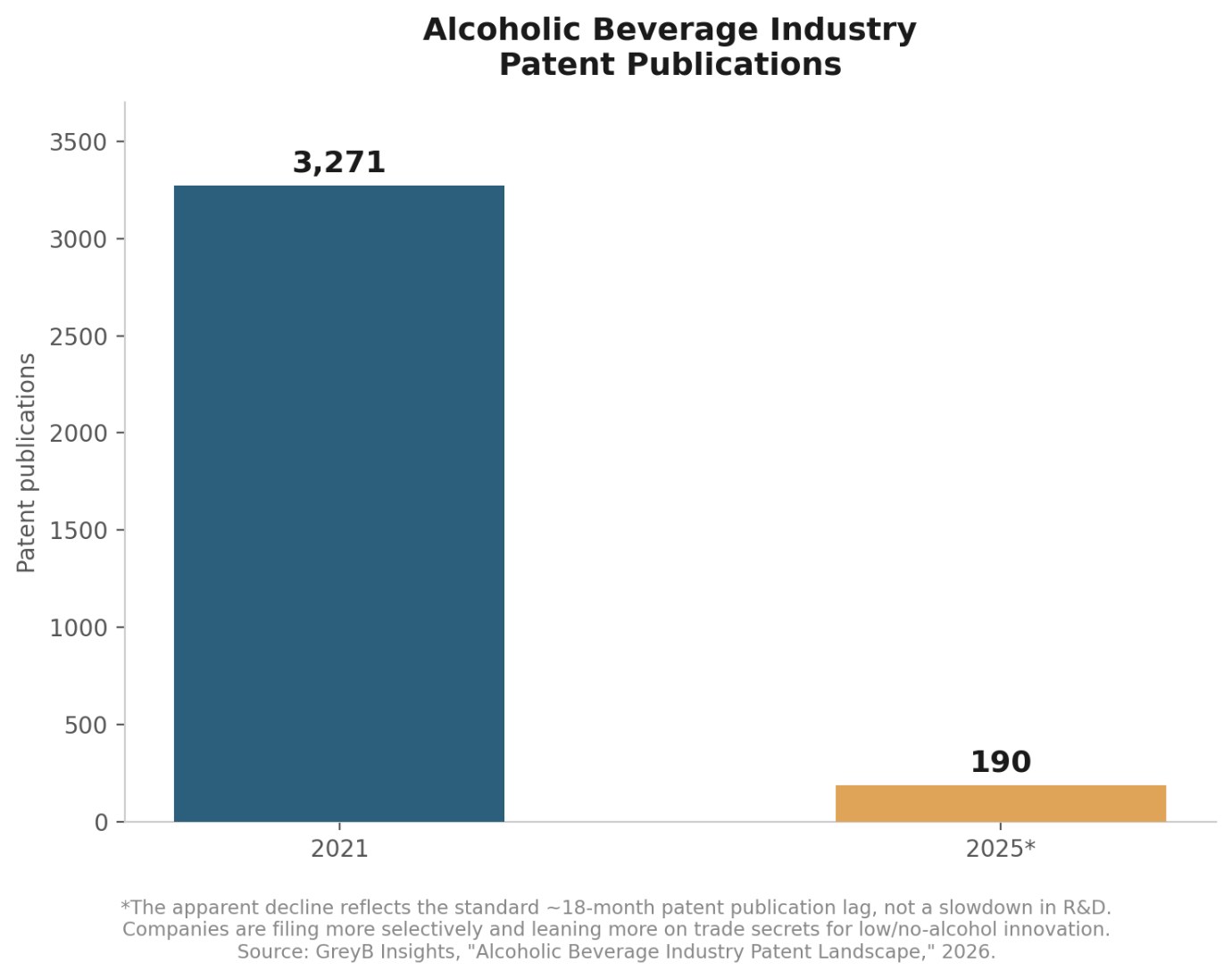
Patent filing data adds an important nuance to this story. A 2026 patent landscape analysis of the alcoholic beverage industry found publications falling from 3,271 in 2021 to just 190 in 2025 but, consistent with the same 18-month publication-lag effect seen in fast-moving technology sectors, this reflects a reporting artifact rather than an actual innovation slowdown. The same analysis notes that companies are becoming more selective about what they patent, increasingly relying on trade secrets, and concentrating filing activity specifically around dealcoholization technology and low/no-alcohol formulation advanced membrane separation, pervaporation, and resin adsorption techniques aimed at stripping alcohol while preserving flavor, historically the hardest technical problem in the category. As recently as July 2026, a newly published international patent application (Kulture Rebellion Corp., WO2026146445A1) proposed using machine-learning models to control fermentation inputs directly engineering a low-alcohol beverage from the start rather than removing alcohol afterward pointing to where the next wave of dealcoholization IP is headed.
What This Means for Different Stakeholders
Beverage manufacturers and CPG portfolio teams are facing a genuine reallocation decision, not a temporary dip to wait out the consistency of the behavioral data across Gallup, EY-Parthenon, FTI Consulting, and clinical trial evidence suggests this is a durable shift in consumption patterns rather than a passing trend.
Ingredient and functional-formulation suppliers sit at the center of the fastest-growing part of this story prebiotic, protein, and functional beverage formulation is where new capital is concentrating (Poppi, Olipop, Oikos), and dealcoholization technology suppliers are positioned at the technical bottleneck the whole non-alcoholic category still needs solved.
M&A and corporate development teams evaluating targets in this space should treat the PepsiCo/Poppi and Keurig Dr Pepper/JDE Peet's deals as data points on where strategic buyers believe durable growth actually sits functional/better-for-you formats and category-focused corporate structures, rather than diversified single-portfolio approaches.
Licensing intermediaries and technology scouts have a specific opportunity in dealcoholization and fermentation-control IP, a technically difficult category where patent filing has historically been thin relative to the size of the commercial opportunity exactly the kind of white space gap that rewards early, well-informed positioning.
Investors assessing this category should weight the demand-side data (Gallup, EY-Parthenon, FTI Consulting, the Lancet trial) alongside the supply-side response (M&A, patent filings, product reformulation) as one connected picture each on its own tells only part of the story.
How This Kind of Intelligence Gets Built
A brief like this only holds up if it's built by reading demand, capital allocation, product reformulation, and IP activity as one connected system rather than four separate reports. The approach we bring to a shift moving this fast typically combines:
**Market research and demand tracking.** Reading consumer survey data from multiple independent sources (Gallup, EY-Parthenon, FTI Consulting) against actual sales data (NielsenIQ, Brewers Association) to separate genuine behavioral change from survey noise.
Competitor and M&A tracking. Following where strategic buyers are actually placing capital the clearest signal of where an industry believes durable growth sits, often ahead of where the broader market consensus has caught up.
Patent family and filing-trend analysis. Reading beverage-technology patent activity correctly, including publication-lag effects, to identify where real innovation such as dealcoholization and fermentation-control IP is concentrating before it becomes obvious.
Technology scouting on formulation and process innovation. Identifying which companies are solving the genuinely hard technical problems in a category like preserving flavor while removing alcohol since that capability, not the marketing positioning around it, is usually where the durable advantage sits.
**Raw-material and ingredient-supplier scouting**, particularly for functional and fortified beverage inputs (prebiotics, protein, specialty botanicals), where demand is scaling faster than many existing supply relationships were built for.
Talk to Us
If your organization is evaluating a reformulation strategy, a category acquisition, a licensing position in dealcoholization or functional-beverage technology, or a supplier relationship anywhere in this shifting beverage landscape, Cognizance builds exactly this kind of evidence-based, source-verified intelligence for better business decisions: technology and competitor scouting, market research, patent and IP analysis, raw-material and supplier scouting, and licensing strategy, grounded in primary data rather than headline dates.
Facing a decision in this space?
We build this level of evidence around the specific choice in front of you, on your timeline.
Discuss a decision