
Blog / Life Sciences
The GLP-1 Patent Cliff: What It Takes to Actually Win a Position in the World's Biggest Drug Class
GLP-1 exclusivity is not one patent cliff. It is five, each governed by a different molecule, pathway and jurisdiction. Read molecule by molecule, the way we build it for a client making a real market-entry decision.
28 July 2026 · 14 min read
The Problem: A Market Decision That Can't Be Made From the Patent Record Alone
GLP-1 receptor agonists the class behind Ozempic, Wegovy, Mounjaro, and Zepbound have become the fastest-growing therapeutic franchise in pharmaceutical history. But for generic and biosimilar manufacturers, telehealth platforms, ingredient and API suppliers, institutional investors, and licensing intermediaries trying to plan around this category, one question dominates every strategy meeting: **where, when, and through whom can we actually enter this market and against whom will we be competing when we do?**
That question can't be answered by reading a patent register alone. It takes patent-timeline clarity, yes, but also market-sizing and demand forecasting, competitor and pipeline tracking, supplier and API-sourcing scouting, and regulatory-and-litigation monitoring, read together as one picture. GLP-1 exclusivity is not one patent cliff it is five separate cliffs, each governed by a different molecule, a different regulatory pathway, and a different jurisdiction. Liraglutide is already generic. Semaglutide's compound patent has expired in India and China but not in the United States. Tirzepatide's core protection runs into the mid-2030s. And a brand-new oral molecule, orforglipron, only received its first approval in April 2026 meaning its competitive and IP position is the youngest, and least understood, of the group.
Layered on top of the expiry timeline is a second, faster-moving battle: patent infringement and antitrust litigation over **compounded and telehealth-distributed versions** of these drugs, which is reshaping who can legally sell a GLP-1 product years before any patent actually lapses and reshaping, in turn, where the real supply-chain and go-to-market opportunities sit.
For a generics manufacturer, ingredient supplier, telehealth operator, or licensing intermediary evaluating entry into this market, getting the timeline wrong by even twelve months can mean the difference between a first-mover advantage and a wasted filing or sourcing commitment. This brief lays out what the public patent record, court filings, market data, and regulatory actions actually show molecule by molecule, jurisdiction by jurisdiction as of mid-2026, the way we'd build it for a client making a real market-entry decision.
Why This Category Is Different From a Typical Small-Molecule Patent Cliff
Most patent cliffs involve a single blockbuster molecule with a reasonably predictable Orange Book listing. GLP-1 therapeutics don't behave that way, for three structural reasons:
- **They span three different regulatory pathways.** Liraglutide and semaglutide are synthesized peptides approved under standard New Drug Applications (NDAs), which means generic competitors can use the Hatch-Waxman ANDA pathway. Tirzepatide is also an NDA product but with a later filing date. Dulaglutide (Trulicity), by contrast, is an Fc-fusion biologic approved under a Biologics License Application (BLA) so any follow-on competitor must go through the BPCIA biosimilar pathway (a 351(k) filing), not a generic ANDA. Orforglipron, the newest entrant, is a small-molecule oral drug on an NDA, filed and approved on an entirely separate timeline from the injectable peptides.
- **Jurisdictions are not synchronized.** Composition-of-matter protection for the same molecule can lapse years apart in different countries, driven by when the underlying patent family was filed and prosecuted in each territory.
- **The commercial fight has moved upstream of patent expiry**, into compounding pharmacies and telehealth distribution, where litigation not the calendar is currently deciding who can sell what.
Molecule-by-Molecule: What the Public Record Shows
Liraglutide (Victoza, Saxenda) Already Generic
Liraglutide's foundational composition-of-matter patents lapsed in major markets by 2023-2024, and generic and biosimilar competition was already underway in Europe well before 2025. In the United States, the first full FDA approval for a generic liraglutide weight-loss product landed in **August 2025** and insurance coverage of the brand-name product reportedly dropped by close to 90% almost immediately after that approval, a striking illustration of how fast payers reallocate once a true generic pathway opens.
Semaglutide (Ozempic, Wegovy, Rybelsus) Expired Abroad, Defended at Home
This is the molecule at the center of the current fight, and it shows the clearest jurisdictional split in the entire category:
- **India:** According to Novo Nordisk's own regulatory disclosures, the semaglutide compound patent expired in India on **20 March 2026**. Following that expiry, several Indian generic manufacturers have sought or received regulatory approval to commercialize generic oral semaglutide.
- **China:** Public patent-tracking analysis places China's semaglutide compound patent expiry on the same date, **20 March 2026** years ahead of the US, EU, and Japan. At least eleven Chinese manufacturers were reported to be in late-stage clinical trials for semaglutide generics ahead of that date, positioning China as a major low-cost supply source for global markets outside the US regulatory perimeter.
- **United States:** The core compound patent US Patent No. 8,129,343, which claims the semaglutide molecule itself does not expire until **December 2031**. Composition-of-matter protection in other major markets, including the EU and Japan, runs on a broadly similar 2031-2032 horizon. Additional formulation and delivery-device patents extend some elements of Novo Nordisk's protection further still.
- **Litigation overlay:** Generic manufacturers have already filed Paragraph IV certifications challenging Novo Nordisk's semaglutide patents, triggering the automatic 30-month FDA approval stays that accompany such challenges. In July 2025, generic manufacturer Viatris secured a favorable ruling in one such dispute a development that market analysts flagged as capable of pulling the US timeline earlier, though most current forecasts still cluster around a **2031-2033** window for full US generic entry, absent a further litigation surprise.
- Novo Nordisk's own oral semaglutide tablet for chronic weight management received FDA approval in **December 2025**, adding yet another product and patent layer to the franchise just as the compound patent was expiring abroad.
Tirzepatide (Mounjaro, Zepbound) The Longest Runway
Eli Lilly's dual GIP/GLP-1 agonist was approved later than semaglutide (2022 for diabetes, 2023 for obesity) and was filed under a distinct patent strategy covering a structurally different molecule. Core composition-of-matter protection is projected to run through approximately **2036**, giving Lilly the longest uncontested exclusivity window of any major branded GLP-1 product a meaningful structural advantage that shows up directly in how the two companies are each approaching pricing, litigation posture, and lifecycle management.
Dulaglutide (Trulicity) A Biosimilar Problem, Not a Generic One
Because dulaglutide is an Fc-fusion biologic, its exclusivity doesn't end with a patent expiry alone BPCIA reference-product exclusivity is set to expire in **September 2026**, after which the earliest biosimilar approvals are plausible on a roughly three-to-five-year horizon. This is a fundamentally different and generally slower pathway than the ANDA route available for the peptide-based products.
Orforglipron (Foundayo) The Newest, Least-Mapped Estate
Eli Lilly's orforglipron became the first once-daily oral, non-peptide GLP-1 receptor agonist approved for chronic weight management when the FDA cleared it as **Foundayo** on **1 April 2026**. Notably, this was the fifth approval granted under the FDA's Commissioner's National Priority Voucher pilot program and, per the FDA's own announcement, the fastest new molecular entity approval the agency has issued since 2002. Because orforglipron is a small molecule rather than a peptide, its patent estate is structured differently from semaglutide's or tirzepatide's, and being the most recently filed of the group is generally expected by analysts to carry exclusivity into the late 2030s, the longest projected runway in the category. Its arrival also directly reshapes the competitive map for any party building a long-term GLP-1 licensing or generics strategy, since it removes "no oral option without patent risk" as a market gap.
At a Glance: Five Molecules, Five Clocks
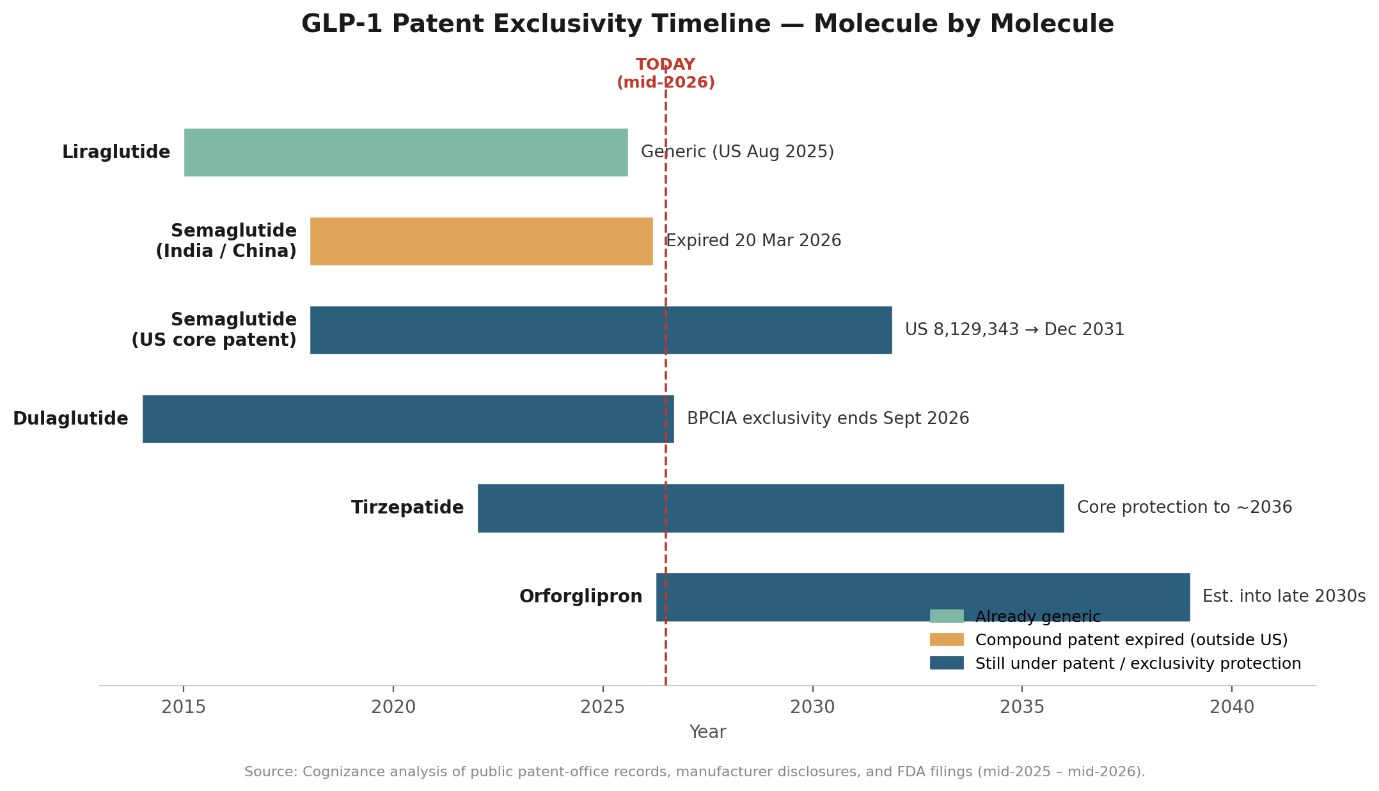
The gap between the orange bar (semaglutide's expired-abroad status) and the navy bar directly beneath it (semaglutide's still-protected US status) is, on its own, the single most important fact in this entire category for anyone planning a market-entry timeline.
The Second Battlefield: Compounding, Telehealth, and Patent Enforcement
While the composition-of-matter timelines above define the *eventual* end of exclusivity, the more immediate and commercially consequential fight in 2025-2026 has been over **compounded versions of these drugs sold through telehealth channels** a battle being fought with patent law and antitrust law well before any core patent expires.
The sequence of public events is instructive:
- **February 2025:** The FDA declared the semaglutide injectable shortage resolved, closing the regulatory loophole (available only during a declared shortage) that had allowed 503A and 503B compounders to legally produce copies of the drug. A short enforcement-discretion grace period followed, ending by late April/May 2025.
- **4 August 2025:** Novo Nordisk filed suit against twelve defendants, including several pharmacies, alleging unlawful marketing and sale of non-FDA-approved products claiming to contain semaglutide a notable strategic shift toward targeting pharmacies directly rather than only upstream compounders.
- **16 September 2025:** The FDA issued more than 55 warning letters to online sellers of compounded semaglutide and tirzepatide products, citing misleading direct-to-consumer marketing.
- **14 January 2026:** Compounding pharmacy Strive filed an antitrust lawsuit against Novo Nordisk, Novo Nordisk Inc., and Eli Lilly in the US District Court for the Western District of Texas, alleging the companies entered into agreements with telehealth companies to exclude compounding pharmacies from the market, among other claims.
- **8-9 February 2026:** Novo Nordisk sent a formal infringement demand letter to telehealth company Hims & Hers, then filed a patent infringement suit against Hims & Hers Health, Inc. in the US District Court for the District of Delaware on **9 February 2026** asserting US Patent No. 8,129,343 (the same core compound patent covering semaglutide) against Hims's compounded and newly announced compounded oral semaglutide product, which Hims had announced days earlier, on 5 February 2026. Novo's complaint alleges willful infringement and seeks enhanced damages, arguing that the regulatory compounding exemptions under FDCA §§ 503A and 503B do not override patent rights or authorize replication of a patented molecule at commercial scale.
Taken together, this sequence shows something important for anyone building a licensing or freedom-to-operate strategy in this space: **the active legal frontier in GLP-1 therapeutics right now is not composition-of-matter novelty it's whether compounding and telehealth distribution models can survive contact with an unexpired core patent.** A generics or telehealth strategy built purely around "the shortage exemption" or "we're just a pharmacy, not a manufacturer" is being tested in real time, in multiple federal courts, simultaneously.
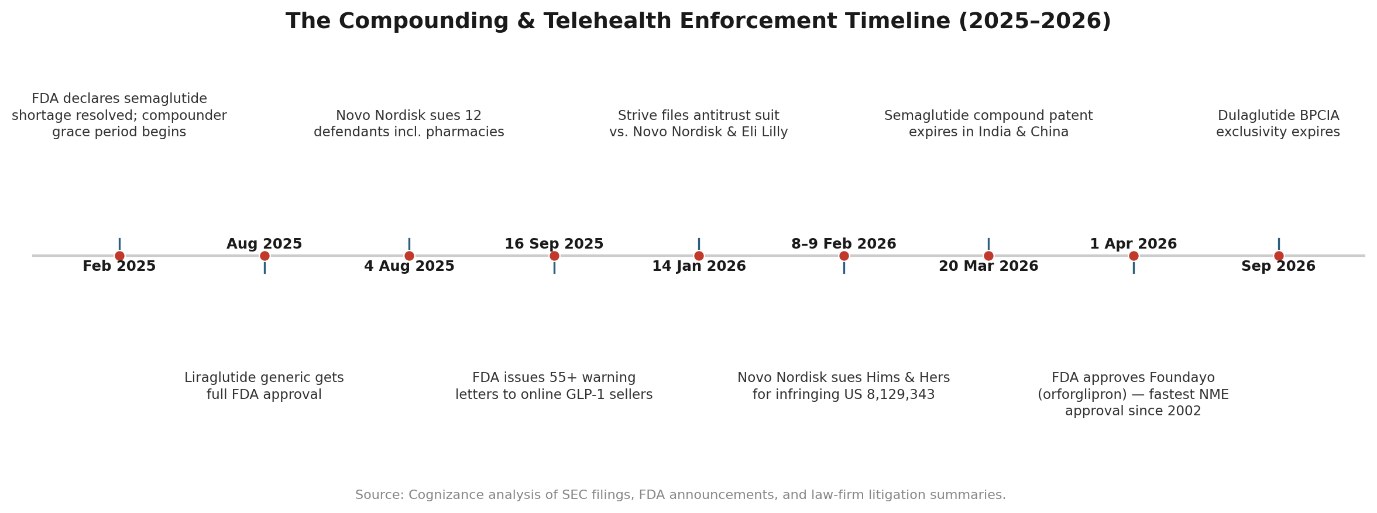
Notice how tightly compressed this is: nine material regulatory or litigation events in roughly thirteen months. That pace, not the 2031-2036 patent-expiry horizon, is what is actually determining market access today.
What the Analysis Shows, at a Glance
| **Molecule** | **Brand(s)** | **Company** | **US Core Patent Status** | **Non-US Status** |
|----|----|----|----|----|
| Liraglutide | Victoza, Saxenda | Novo Nordisk | Generic approved Aug 2025 | Generic since 2023-2024 (EU) |
| Semaglutide | Ozempic, Wegovy, Rybelsus | Novo Nordisk | Compound patent to ~Dec 2031; litigation ongoing | Expired India & China, 20 Mar 2026 |
| Tirzepatide | Mounjaro, Zepbound | Eli Lilly | Core protection to ~2036 | Broadly similar, later-filed estate |
| Dulaglutide | Trulicity | Eli Lilly | BLA BPCIA exclusivity ends Sept 2026 | Biosimilar pathway, not ANDA |
| Orforglipron | Foundayo | Eli Lilly | Approved Apr 2026; youngest estate, est. into late 2030s | Newly filed, not yet widely litigated |
*(Estimates for outer-year expiries reflect current public patent-office listings and manufacturer disclosures as of mid-2026; actual dates remain subject to ongoing litigation, settlement agreements, and pediatric-exclusivity extensions.)*
What This Means for Different Stakeholders
**Generic and biosimilar manufacturers** evaluating GLP-1 entry face a genuinely bifurcated opportunity: near-term, lower-risk entry in India, China, and other markets where the semaglutide compound patent has already lapsed, versus a longer, litigation-contingent runway in the US and EU where Paragraph IV strategy and settlement timing will determine actual launch dates far more than the nominal expiry year. For these manufacturers, the patent timeline is only step one it needs to be paired with API and raw-material supplier scouting in the newly-open markets, since production capacity and qualified supply, not just legal clearance, will decide who actually gets product to market first.
**Telehealth and DTC platforms** operating compounding-adjacent business models are now navigating simultaneous patent infringement and antitrust exposure the Hims & Hers and Strive matters show both sides of that coin playing out in parallel litigation. For these players, the decision to enter, exit, or restructure a compounding relationship is as much a competitor-intelligence and regulatory-monitoring question as it is a legal one.
**Ingredient, API, and device suppliers** watching this category need visibility into which molecules are opening up in which geographies, and on what timeline, to size manufacturing investment correctly the India/China compound-patent expiry is as relevant to a contract manufacturer's capacity-planning decision as it is to a generics company's launch date.
**Licensing intermediaries and IP monetization advisors** have a genuine white-space opportunity in the gap between "compound patent expiry" and "actual generic market entry" the multi-year window where formulation patents, device patents, and active litigation still control commercial access even after the headline composition-of-matter patent has lapsed.
**Investors and corporate development teams** assessing this category need molecule-specific, jurisdiction-specific patent mapping combined with market-sizing and competitive-landscape data, read as one picture, rather than a single "GLP-1 patent cliff" date as this analysis shows, that single date does not exist, and neither does a single lens that explains the whole opportunity.
How This Kind of Intelligence Gets Built
A brief like this is only useful to a business decision if it's built the way the decision actually gets made as one connected picture, not five disconnected reports. The approach we apply to a landscape of this complexity typically involves:
**Patent family and claim mapping.** Tracing each molecule's global patent family compound, formulation, device, and method-of-use claims jurisdiction by jurisdiction, rather than relying on a single headline expiry date that rarely tells the whole story.
**Evidence of Use (EoU) analysis on emerging commercial models.** Mapping how compounded, telehealth-distributed, and oral reformulated products actually read onto asserted claims the exact question now being litigated in the Novo Nordisk v. Hims & Hers matter to assess infringement exposure before a demand letter arrives, not after.
**Market research and competitor tracking.** Sizing the addressable opportunity in each newly-open geography and tracking how incumbents (Novo Nordisk, Eli Lilly) and challengers are actually moving product launches, pricing actions, litigation posture, and lifecycle strategy so a market-entry decision reflects where competitors are headed, not just where they are today.
**Raw-material and supplier scouting.** Identifying and evaluating qualified API manufacturers, contract manufacturers, and device suppliers in the geographies where patent protection has lapsed because a generics or biosimilar strategy is only as fast as its slowest supply-chain link.
**White space and licensing-opportunity identification.** Pinpointing where formulation, delivery-device, or manufacturing-process patents remain open even after a compound patent expires often the more commercially relevant window than the compound patent itself.
**Litigation and regulatory monitoring as a continuous signal**, not a one-time snapshot because in a category this active, the legal and regulatory posture (FDA shortage determinations, Paragraph IV filings, antitrust complaints) can move faster than the underlying science.
Talk to Us
If your organization is evaluating entry, sourcing, licensing, or competitive strategy anywhere in the GLP-1 category or in any other fast-moving life sciences technology where the real opportunity sits inside the gaps between patent status, market readiness, and supply chain Cognizance builds exactly this kind of evidence-based, source-verified intelligence for better business decisions: technology and competitor scouting, market research, patent and IP analysis, raw-material and supplier scouting, and licensing strategy, grounded in primary data rather than headline dates.
[**Get in touch with our team →**](https://cognizanceip.com/)
Facing a decision in this space?
We build this level of evidence around the specific choice in front of you, on your timeline.
Discuss a decision